
Reviewed · WALKING TOURS
Discover Valletta Half-Day Walking Tour
Valletta rewards curious walkers. This three-hour-15-minute group tour gives you a useful first look at Malta’s compact capital, from the Triton Fountain and City Gate to the Grand Harbour views at Upper Barrakka Gardens. I like the low $22.11 price and the way the route covers many major sights without taking your whole day. I also like the 45 minutes of free time at St. John’s Co-Cathedral, since you can pay to enter, shop, or simply sit in a square.
The main caution is the group format, which can reach 50 people. One booking review praised guides Josephine and Maria for their warmth and ability to explain Malta, while another described a bilingual tour with explanations that felt too basic. If you want a personal, detailed history lesson, the guide and group size may shape your experience more than the itinerary does.
In This Review
- Key points before you book
- What the $22.11 price really gets you
- Meeting the guide at Triton Fountain
- Renzo Piano’s modern entrance to an old city
- Auberge de Castille and Upper Barrakka Gardens
- Auberge d’Italie and the central palaces
- Your 45 minutes at St. John’s Co-Cathedral
- St. George’s Square and the Grandmaster’s Palace
- Fort Saint Elmo and the final stop
- The guide can make or break the morning
- Who should book this Valletta walk?
- Final verdict: a useful first morning in Valletta
- FAQ
- How long does the Valletta walking tour last?
- Where does the tour start?
- Where does the tour finish?
- Is admission to St. John’s Co-Cathedral included?
- Can I visit St. John’s Co-Cathedral during the tour?
- Is The Malta Experience included?
- What languages are available?
- How large can the group be?
- Is hotel transportation provided?
- Can I cancel for a refund?
Key points before you book
- Starts at 9:15 a.m. outside Valletta: Meet at The Phoenicia Malta in Floriana, near the Triton Fountain and City Gate.
- Covers a lot in just over three hours: You pass major monuments, gardens, squares, forts, and palaces on foot.
- Upper Barrakka Gardens supplies the big view: You get free time to look across the Grand Harbour and the Three Cities.
- St. John’s Co-Cathedral is optional: The tour gives you 45 minutes to buy admission, shop, or stop for coffee.
- The group may be large: Up to 50 people can join, so this is a budget introduction rather than a private walk.
- Ends near The Malta Experience at 12:45 p.m.: You can add the 1 p.m. audiovisual show at your own expense.
What the $22.11 price really gets you
At $22.11 per person, this tour is priced as an economical orientation walk. You are paying for a licensed guide and a planned route through Valletta, not for entry to the city’s museums, cathedral, palace, or audiovisual show.
That distinction matters. Valletta’s best indoor sights often charge separate admission, and this arrangement lets you choose where your money goes. If you already know you want to see Caravaggio’s paintings at St. John’s Co-Cathedral, you can buy that ticket. If you prefer public spaces, architecture, and views, you can skip paid sites and still see a great deal.
I see the tour as especially useful on a first morning in Malta. It gives you a sense of the city’s shape and its major landmarks, then leaves the afternoon open. You can return to a museum, have lunch, shop along Republic Street, or continue exploring on your own.
The group setup keeps the cost down, but it also means you should not expect every question to receive a long answer. A maximum of 50 people is a sizeable crowd for narrow streets and busy public squares. The guide may need to gather everyone at set points, and the pace can feel less flexible than on a private walk.
The experience is usually booked about 35 days ahead, which suggests you should reserve early if the 9:15 a.m. start fits your plans. Confirmation is normally issued at booking. If you book within 14 hours of departure, confirmation arrives as soon as possible and depends on availability.
More walking tours on foot:
- The Original Valletta Walking Tour
★ 5.0 · 2,719 reviews - Valletta: 3-Hour Walking Tour
★ 4.7 · 1,605 reviews - Valletta: Guided City Walking Tour
★ 4.8 · 1,256 reviews
Meeting the guide at Triton Fountain
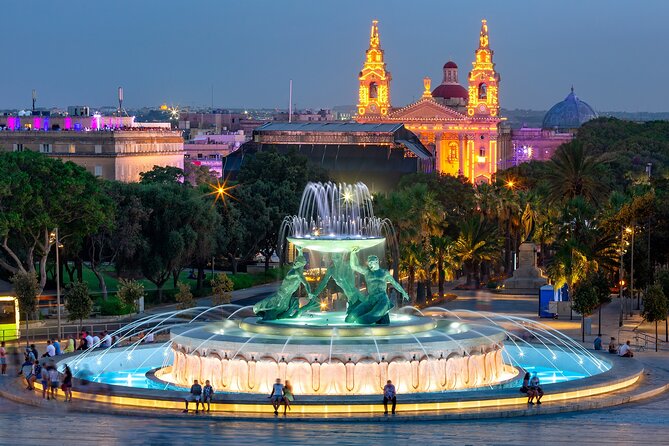
The tour begins at The Phoenicia Malta, The Mall, Floriana, at 9:15 a.m. The meeting point is outside Valletta’s main entrance area, making the route easy to identify. The first landmark is the Triton Fountain, just outside the City Gate.
The fountain features three bronze Tritons supporting a large basin. Inaugurated in 1959 and restored in 2018, it is an important Modernist work in Malta. It also gives you a clear visual introduction to the meeting area before the walk moves into the fortified city.
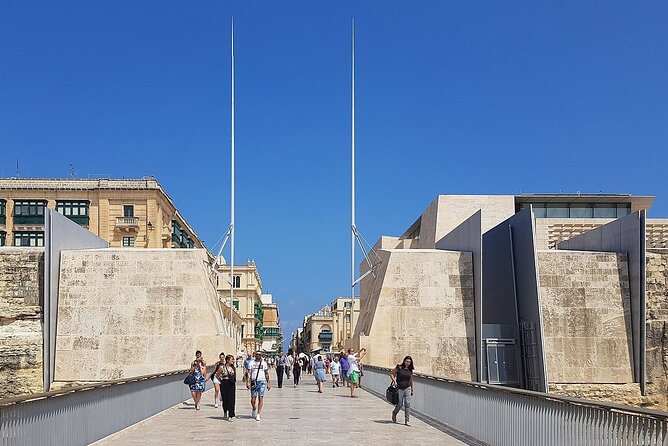
From here, you reach Valletta City Gate. The present gate was designed by Italian architect Renzo Piano and completed in 2014. It is the fifth gate built on this site, which sits between St. James’ and St. John’s Bastions across Valletta’s deep ditch.
The gate marks the start of Republic Street, Valletta’s main thoroughfare. That street runs through the city toward Fort Saint Elmo, so this first stop helps you understand Valletta’s basic layout: a planned grid on a narrow peninsula, framed by defensive walls and harbours.
Renzo Piano’s modern entrance to an old city
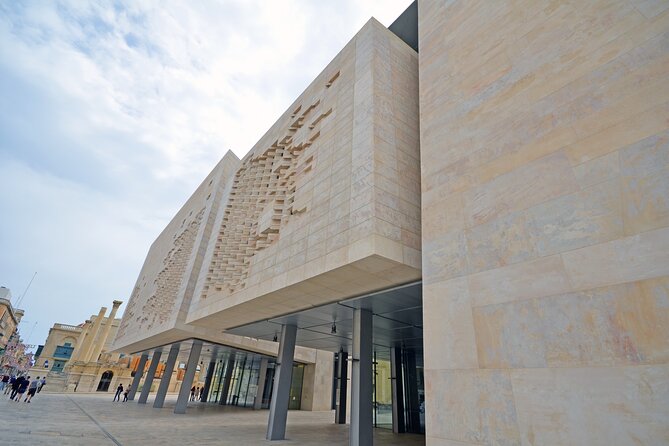
The opening section pairs old military planning with new architecture. The New Parliament, also designed by Renzo Piano, was built between 2011 and 2015 as part of the City Gate project.
The building is formed from two blocks linked by bridges. Its steel frame is clad in Gozitan limestone, with a pattern intended to suggest honeycombs. Malta’s name is linked to Melite, meaning honey, so the design makes a modern reference to the island’s ancient identity.
You will not spend long at this stop, and admission is not included. That is fine for an outdoor orientation walk. The value here is seeing how present-day Malta has placed new public buildings beside much older walls and monuments.
Nearby, the Royal Opera House site tells a harder story. The original theatre, designed by Edward Middleton Barry, opened in 1866 and was destroyed by an aerial bomb in 1942. Renzo Piano later redesigned the ruins, and the site returned to use as a performance venue in 2013.
The stop is brief, so you should not expect a full account of wartime Valletta. Still, the open-air remains make the effects of war easy to grasp. The ruined structure is not simply erased or rebuilt as before. It has been given a new role.
Auberge de Castille and Upper Barrakka Gardens
Auberge de Castille sits at Valletta’s highest point. Built in the Baroque style during the 1740s under Grand Master Manuel Pinto da Fonseca, it replaced an earlier building used by knights from the Castile, León, and Portugal section of the Order of St. John.
Today, the building houses Malta’s Office of the Prime Minister. You view it from outside, and admission is not part of the tour. Its position and grand façade make it one of the essential architectural stops, even if the five-minute visit is more about seeing and hearing than entering.
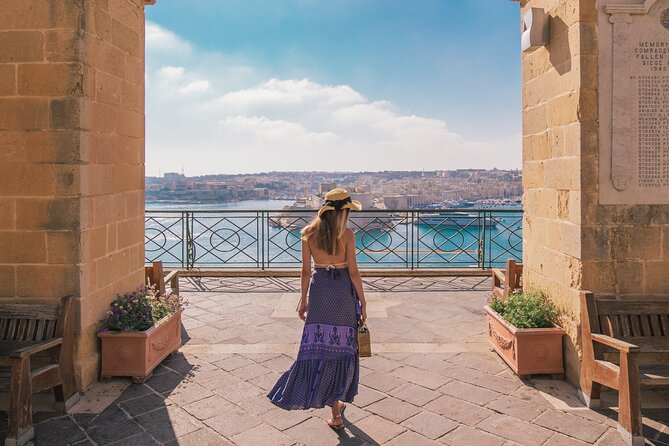
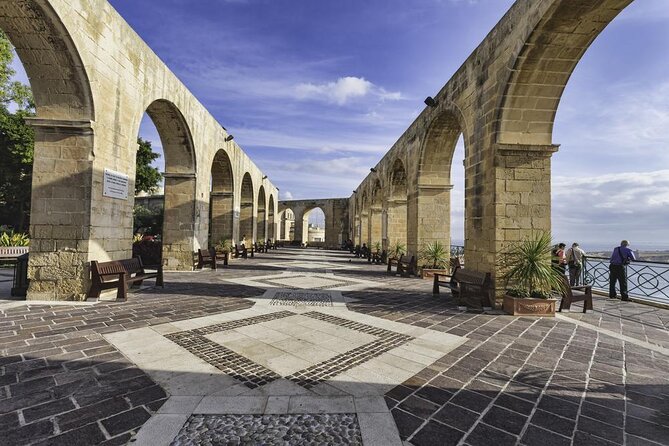
The route then reaches Upper Barrakka Gardens, one of the tour’s best pauses. The gardens occupy the upper level of St. Peter and St. Paul Bastion, built in the 1560s. They were first used as a place of recreation for knights from the Italian section of the Order of St. John.
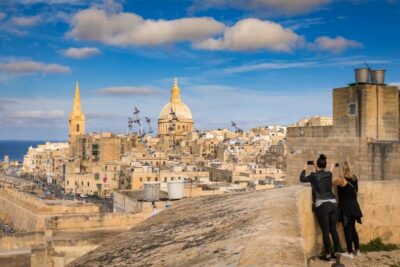
You get about 15 minutes of free time here. From the terrace, you can look across the Grand Harbour toward the Three Cities, the shipyard, and the lower parts of Valletta. Since the gardens sit at the highest point of the city walls, this is the clearest place on the route to grasp Valletta’s relationship with the water and its neighbouring fortified towns.
The short break is useful. A walking tour can become a parade of façades, but the view gives the city room to breathe. Bring your camera, but also take a moment to study the harbour layout. The guide may point out features from the terrace, but you will have some freedom to enjoy the scene at your own pace.
A few more Malta trips worth weighing up
- Half Day Private Tour around the Island in Malta
★ 5.0 · 211 reviews - Malta: Half-Day Quad Bike Adventure Tour Including Transfers
★ 4.7 · 185 reviews - Valletta: Half-Day City Discovery Walking Tour
★ 3.9 · 157 reviews - Half-Day Tour of Mosta, Ta’Qali Crafts Village & Mdina
★ 4.1 · 110 reviews
Auberge d’Italie and the central palaces
Auberge d’Italie was built in the late 16th century for knights from the Italian section of the Order of St. John. Since 2018, it has housed MUŻA, Malta’s National Art Museum.
The tour does not include admission, and the stop lasts about five minutes. If you are interested in art, note its location for a later visit. The walking tour gives you the building’s role and current use, but not enough time to explore the collection.
Palazzo Parisio adds another layer to Valletta’s political past. Built in the 1740s by Domenico Sceberras, it later passed through the Muscati and Parisio Muscati families. Napoleon stayed there for six days in June 1798 during the early French occupation of Malta.
The building later served as the General Post Office from 1886 to 1973 and then housed the Ministry for Agriculture. It now contains the Ministry for Foreign Affairs. This is a good example of how Valletta’s grand residences have changed function over time. You see the exterior and hear the story, but entrance is not included.
Your 45 minutes at St. John’s Co-Cathedral
The longest independent pause comes at St. John’s Co-Cathedral on Republic Street. You have 45 minutes to decide how to use it, and that choice is central to the tour’s value.
You can buy admission to the cathedral and museum, including the Oratory with Caravaggio masterpieces, the Flemish tapestries, and the church museum. The ticket also includes a multilingual audio guide. The cathedral’s marble inlaid floor is one of its most striking features, so anyone interested in art, religious buildings, or the Order of St. John should consider paying to enter.
The tour does not cover that admission fee. This keeps the basic price low, but you should budget separately if the cathedral is a priority. Forty-five minutes gives you a meaningful look, though it is not an afternoon-length visit.
If you skip the cathedral, the free time still works well. Republic Street is Valletta’s main shopping street, and you can stop at a café in Republic Square or one of the nearby piazzas. You must return to the agreed meeting place at the agreed time, so do not wander too far.
This pause also reveals the tradeoff between a fixed group tour and independent sightseeing. You get a clear block of personal time, but the schedule is not open-ended. If you want to linger over every chapel detail, you may prefer to return later on your own.
St. George’s Square and the Grandmaster’s Palace
After the cathedral break, the group continues to St. George’s Square, also called Palace Square. It is Valletta’s largest and most prominent square, directly in front of the Grandmaster’s Palace.
The square has changed since the 17th century, but it remains an important setting for public ceremonies and events. Its size gives the guide a useful place to regroup, and its position helps connect the cathedral area with the city’s main administrative buildings.
The Grandmaster’s Palace was built between the 16th and 18th centuries for the leaders of the Order of St. John. It later served as the seat of Malta’s Parliament from 1921 to 2015. Today it houses the Office of the President, while the State Rooms and Palace Armoury are open to the public as a museum.
Again, the tour only allows a short exterior visit. If you want the interiors, plan a separate visit and pay the admission fee. The guided stop is still worthwhile because the palace is central to understanding how Valletta moved from the rule of the knights to modern government.
Fort Saint Elmo and the final stop
The walk continues toward Fort Saint Elmo at the tip of the Sciberras Peninsula. The fort controls the entrances to both Marsamxett Harbour and Grand Harbour, along with Fort Tigné and Fort Ricasoli.
Fort Saint Elmo is closely tied to the Great Siege of Malta in 1565. Since 1975, part of the fort has housed the National War Museum. The five-minute stop is enough to place the fort on your mental map and hear why its position mattered, but not enough for a museum visit.
The tour ends at The Malta Experience, at St. Elmo Bastions, around 12:45 p.m. You can buy a ticket for the 1 p.m. multilingual audiovisual show, which lasts 45 minutes and presents Malta’s story through the centuries. You can also buy a drink or snack while looking over the Grand Harbour.
This ending is practical. If you want a structured history presentation after the walking tour, the timing lines up neatly. If not, you can leave at your own pace and continue exploring Valletta. Hotel pickup and drop-off are not included, so you make your own way back.
The guide can make or break the morning
The tour is offered with an English, French, German, Italian, or Spanish-speaking licensed guide, according to the language booked. The feedback points to a real strength: Josephine was praised for making the half-day fun, and Maria was praised for her warmth and ability to accompany the group through Valletta.
There is also a warning worth taking seriously. One booking described a bilingual tour with basic explanations and little depth. The provider noted that tours normally run in one language, though two languages can occasionally be used. If historical detail matters to you, confirm your preferred language and be prepared for some variation in delivery.
Another comment described a long wait while the full group assembled, despite the person arriving on time. That does not appear in every account, but it is a sensible reason to arrive early and expect the start to take a little patience.
Who should book this Valletta walk?
I would choose this tour if you want a budget-friendly first orientation and prefer a guide to handle the route. It suits people with one morning free, cruise passengers with limited time, and anyone who wants to see the main streets before returning to selected sights later.
It also suits you if you like having choices. Paid admissions are not bundled into the price, so you can decide at St. John’s Co-Cathedral or The Malta Experience instead of paying for attractions you may not want.
I would think twice if you want a quiet, highly personal walk or a detailed academic discussion of Malta’s past. The maximum group size is 50, many stops last only five minutes, and one experience was weakened by basic bilingual commentary.
Most people can participate, and service animals are allowed. The route is near public transportation, though hotel transportation is not provided. Free cancellation is available up to 24 hours before the 9:15 a.m. start for a full refund. Changes or cancellations inside that window are not accepted.
Final verdict: a useful first morning in Valletta
The Discover Valletta Half-Day Walking Tour offers good value for its price. You see the city gate, Renzo Piano’s modern additions, Baroque palaces, Upper Barrakka Gardens, St. John’s area, the Grandmaster’s Palace, and Fort Saint Elmo before lunch.
Its best features are the broad route, harbour views, and the flexible 45-minute cathedral break. Its weak points are the potentially large group, short stops, and uneven guide depth.
Book it if you want a sensible introduction, a low upfront cost, and a free afternoon afterward. Skip it in favour of a private or smaller walk if you care most about detailed questions, slow observation, and a more tailored pace.
FAQ
How long does the Valletta walking tour last?
The tour lasts approximately three hours and 15 minutes. It begins at 9:15 a.m. and ends at The Malta Experience around 12:45 p.m.
Where does the tour start?
The meeting point is The Phoenicia Malta, The Mall, FRN1478, in Floriana, Malta. It is near the Triton Fountain and Valletta City Gate.
Where does the tour finish?
The tour ends at The Malta Experience, St. Elmo Bastions, Triq Il-Mediterran, Valletta VLT 1253.
Is admission to St. John’s Co-Cathedral included?
No. The tour provides 45 minutes of free time at St. John’s Co-Cathedral, but entrance to the cathedral and museum must be purchased separately.
Can I visit St. John’s Co-Cathedral during the tour?
Yes. You can use the 45-minute break to buy admission and visit the cathedral, museum, Caravaggio Oratory, Flemish tapestries, and church museum. A multilingual audio guide is included with cathedral admission.
Is The Malta Experience included?
No. The tour ends at its entrance, and you can purchase a separate ticket for the 1 p.m. multilingual audiovisual show.
What languages are available?
The licensed guide may speak English, French, German, Italian, or Spanish, according to the language booked. Tours normally run in one language, though two languages may occasionally be used.
How large can the group be?
The activity can have a maximum of 50 people. It is a group walking tour designed to keep the cost down.
Is hotel transportation provided?
No. Hotel pickup and drop-off are not included. The meeting point is near public transportation, and you make your own way back after the tour.
Can I cancel for a refund?
Yes. You can cancel at least 24 hours before the experience start time for a full refund. Cancellations or changes made less than 24 hours before the start are not accepted.
Just added around Malta
- Gozo Unveiled: Guided Hiking in Gozo – The West★ 5.0 · 3 reviews
- Half Day Tour in Marsaxlokk Village, Market, Blue Grotto & Qrendi★ 4.5 · 3 reviews
- Tour of Malta (Private Driver) Including Lunch Platter & Wine in the countryside★ 4.5 · 3 reviews
- Valletta City of Gentlemen guided walking tour★ 3.5 · 3 reviews
- Sunday: Ghajn Tuffieha (Riviera) Beach Yoga Class★ 5.0 · 3 reviews
- Pastizzi Making Experience in Malta★ 5.0 · 3 reviews
- Malta: Around Comino Cruise With Blue Lagoon stop★ 5.0 · 3 reviews
- Half Day Private Tour around the Island in Malta★ 4.7 · 3 reviews
Walking Tours, compared.

Guided Walking Tour with Optional Cathedral Tour
Read our review →
The Valletta Street Food and Culture Walking Tour
Read our review →Browse the lists this tour appears in